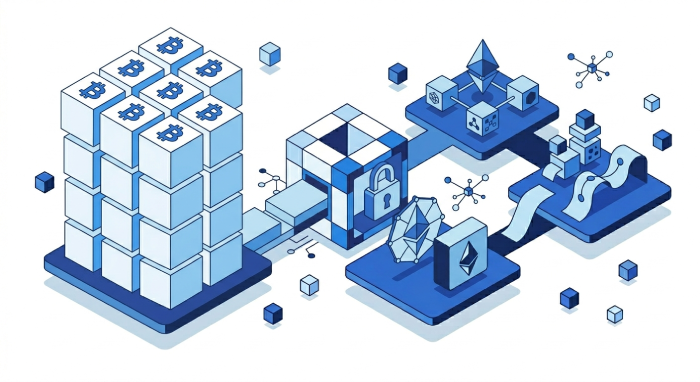

A high-level walkthrough of the blockchain, mining, halvings, and how transactions move from your wallet to the network.
At a high level: Bitcoin is a digital ledger that thousands of computers around the world keep in sync without any central authority. The ledger is the blockchain, the computers are nodes and miners, and the security is provided by mathematics, electricity, and the financial incentives baked into the protocol.
The blockchain
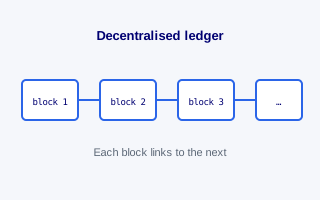
The blockchain is just a list of every transaction that has ever happened, grouped into “blocks” that link to each other in order. Anyone can download the whole list and check for themselves that the rules have been followed. New blocks are added roughly every 10 minutes.
Mining
To add a new block, miners compete to solve a cryptographic puzzle. The first one to solve it gets to write the next block and receives newly minted Bitcoin (the block reward) plus the transaction fees from that block. This process — called proof of work — makes the chain expensive to attack.
The halving and the 21-million cap
Every 210,000 blocks (about every four years), the block reward is cut in half. This is called the halving. Combined, the halvings mean the total supply will never exceed 21,000,000 BTC — a hard ceiling encoded in Bitcoin’s rules.
How a transaction actually works
- You sign a message with your private key saying “send X BTC from my address to address Y.”
- Your wallet broadcasts that signed message to the network.
- Nodes verify the signature is valid and the funds are actually yours.
- A miner includes the transaction in the next block.
- After roughly six blocks (about an hour), the transaction is considered final.
Frequently asked questions
Why is Bitcoin secure?
Because rewriting history would require redoing all the proof-of-work since that point — an enormous amount of electricity that grows every day.
How long does a transaction take?
A new block is mined roughly every 10 minutes. Most exchanges treat 1–6 confirmations as “final” depending on the amount.
Why are there transaction fees?
Fees pay miners to include your transaction in a block. They also stop the network from being spammed.
What happens after all 21 million BTC are mined?
Miners will be rewarded purely by transaction fees. That’s expected to happen around the year 2140.
Is mining bad for the environment?
Bitcoin mining uses real-world electricity. Whether that’s acceptable is a values question. The trend in the industry is toward renewables and stranded energy.
Go deeper
Glossary terms